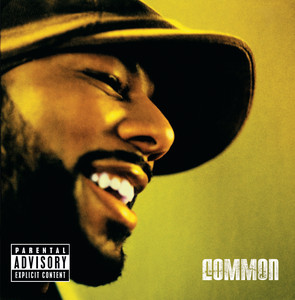
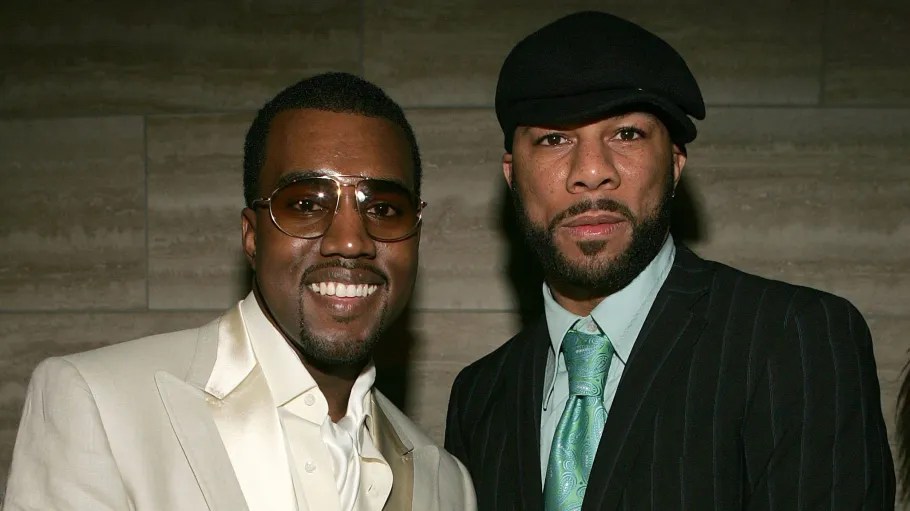
20 years ago, after facing scrutiny for his previous record titled ‘Electric Circus’, Common released Be. Unlike the album before it, Be went back to Common’s roots of Soulquarian production with help from an up-and-coming producer from Roc-A-Fella records, Kanye West. At this time, Kanye had just come off of one of the best albums of 2004 The College Dropout (Common even appeared on “Get Em High”), and produced two major hits for Twista, another Chicago native (“Slow Jamz” & “Overnight Celebrity”). These two Chi-town artists seemed like a match made in heaven, especially since Kanye’s biggest influences were (I don’t know about now) J Dilla and No I.D.; the two producers that Common works best with. Every single hip-hop head knew that these two linking up would produce a classic…and boy oh boy did we get one (Almost all the songs that I will mention are from this short film that I made. If it isn’t, I will link it with the title).
I think it is safe to say that out of any hip-hop album ever, Be has the greatest intro track of them all. First, the build up is insane. The song starts with bass only, then we get synths, then pianos, then finally horns and drums. I will talk about the instrumental more when I finally get to the midwest edition of “Every Producers Best Sample Flip”, but I will talk about what Common says. On the track, Lynn describes being free. Just as free as the dead, without any scrutiny by the public or his peers. He is stressed out by the current world and by the Bush administration, until he looks in his daughters eyes and realizes that he just wants to be— ‘Be’ meaning to live in the present and focus on himself and his family, without the weight of anyone else being on his shoulders. The closing line: “Never looking back, or too far in front of me. The present is a gift, and I just want to be.” gives me chills.
Even though this album goes into many different emotions, I feel like the songs on Be can be wrapped up into three distinct categories: love, hometown praise, and hate for the critics.
Category 1: Love
Like every English teacher since the history of time has said – love is a difficult word. Trying to sum up the meaning of love is damn-near impossible. But, Common talks about love a lot on Be, but mostly on “Go!”, “Faithful”, and “Love Is”. All three are different interpretations of love. “Go!” talks about the spiciest part of love: sex. Even though the beat is warm and uplifting, “Go!” is perhaps one of the dirtiest songs in hip-hop. Almost every single punchline is a sexual innuendo (“Little red corvette no she was faster”). And, if it isn’t, it is blatantly describing the spiciness (“The type at the club n****s would grab her”). Meanwhile “Faithful” is all about not only faithfulness to your partner, but to God. Because if God was a woman, would Common treat Her the same (not talking about H.E.R.)? Also, while I’m on the subject of “Faithful”, I have to mention how amazing the outro by John Legend is. It speaks directly to your soul and reminds the listener about how great it is to be faithful to your partner.
“Love Is” is one of the only songs on the record produced by J Dilla, and it is immaculate. The instrumental is a flip of the B-Side version of Marvin Gaye’s “God is Love”, and Dilla chops it up to perfection. On the lyrics side, Common talks about how love is seen in the hood, and how it is not encouraged by his peers. Common raps, “I knew this girl with a son who dreamt of acting in plays. Demonstration with her man had her trapped in a maze. Trying to find herself again, much of that she’d have gave.” It is sad really, but the soulful Dilla instrumental gives you hope for better days in the hood. Speaking of Chi-town…
Category 2: Hometown Praise
Throughout his career, Lonnie Lynn has always repped Chicago, way before it was cool. He was pretty much the Windy City’s first mainstream rapper, paving the way for artists like Kanye, Twista, Lupe, Polo G, Chief Keef etc. So, the two songs that show love to Chicago are both very grimy. “The Corner” talks about all the corners in the hood areas of Chi-town that helped raise him into that man he became today. I don’t know if it was intentional, but each verse has Common rap in a different number of syllables. His first verse has his last line end in one syllable (Clothes, O’s, roll, cold), his second verse has the last line end in two (street lights, be like, breathe nights, believe hype), and the third verse is masterful, with a flurry of multi-syllable rhymes. “Chi-City” is the same, but it is definitely more straightforward. It is just Common talking his sh*t, and him noting how much he loves Illinois’ capital.
Category 3: Hate For the Critics
Like I said in the intro, many critics thought that Common’s most recent album at the time, Electric Circus, was a huge flop. And, in all honesty, they were right. The album only had one hit single, “Come Close”, and one can argue that song was carried by Mary J. Blige on the hook. And so, the critics started not only blasting Common for the album, but for his style, his relationship problems, and how he isn’t hip-hop anymore. Obviously, Common hated that, and punched back hard on Be, but more specifically, “They Say”. “They Say” is Common putting the haters on full blast, not giving a f**k about what they say. Both Common and Kanye spit verses about what the critics say about them in the press. Common talks about the criticism of him being too conscious and how he went too left field on his previous record (“They say dude think he righteous”, “Play my cards right, they say I went too left”). Meanwhile Kanye talks about the media calling him crazy (things really haven’t changed since 2005) and how the press will make fun of you for falling off (“…you be up so high, if you ever fall off, it feel like a plane crash”). Side note: the Ahmad Jamal sample on the production is amazing! In my opinion, this might be Common’s best song ever. It is for sure up there with “Communism”, “The People”, “Dreamin’”, “Dooinit” and of course…
“The Food”
There aren’t many songs in music that make me go “Wow!”, but “The Food” is one of them. Immediately the track hooks you in with the piano 4 count, then drags you in with a call-and- response chorus about everyday life in Chicago. If you wanted to sum up what this album is all about, I would 100% use this chorus as an example. Then, Common spends two verses detailing what the street life is all about in Chi-Town. But, with the instrumental behind him it sounds… inspiring. Common is using the song as a way to tell the newer generation that they can get through it just like he did. After Common’s verses, we get another run through of the hook. But then, Kanye sings the bridge: “I, I know I could make it right, If I could just swallow my pride. But I can’t run away or put my gun away – you can’t front on me.”
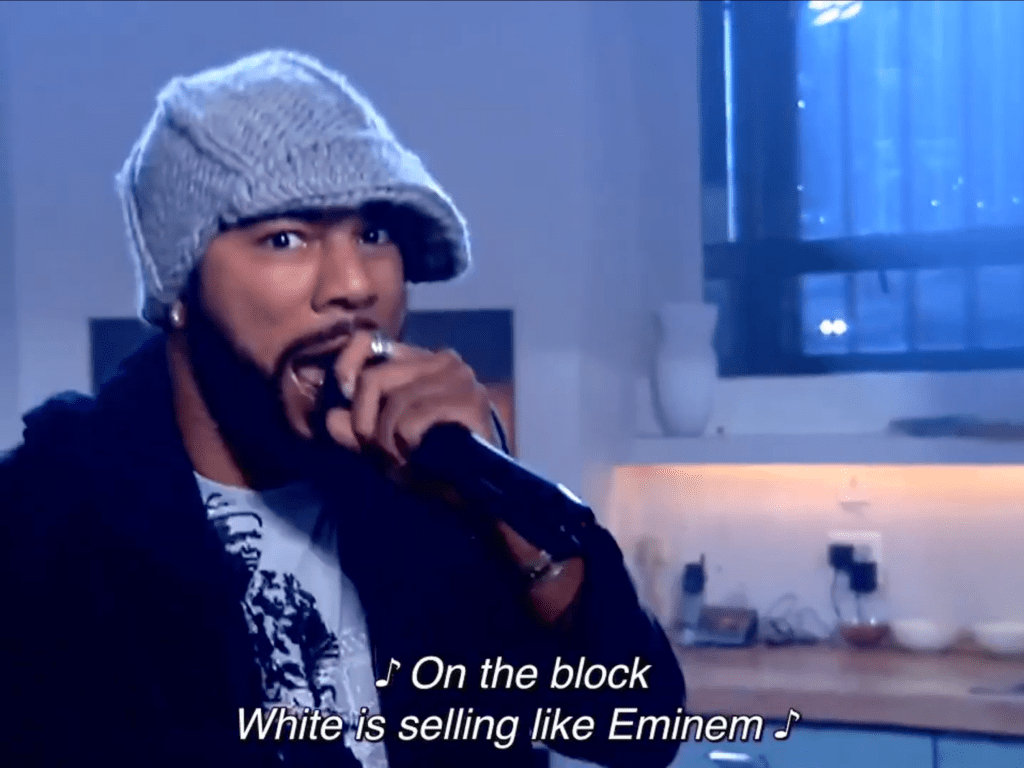
So, I went to see Common & Pete Rock at the Blue Note. And when they performed this song, the entire crowd sang the bridge at the top of their lungs like it was the national anthem. And Common was sitting back smiling. It felt like he knew that his music reached the audience he intended it to reach so many years ago. And, he couldn’t be more happy. (Also, the version on the album is the Chappelle Show performance, which is one of the best performances on the show. And unprecedented that a song’s album version occurred in one take on a tv show!)
Last month, influencer/content creator Druski posted a video making fun of so-called “woke rappers”, and obviously, this was a shot at Common and Talib Kweli (also Masta Killa from Wu-Tang). He even wore that hat that Common wears in the Be album cover. The whole gist of the video is that rappers like Kweli and Common care too much about black culture. But, isn’t the music still good? I feel like people make fun of “backpack” rappers because they are too “nerdy” for a genre that was based out of the Bronx. But, without rappers like Mos Def, Black Thought, and Common, we wouldn’t have artists like Kendrick or Cole, and we for sure wouldn’t have Odd Future, whose whole thing is about being different from the main rap consensus. So what would you choose, some “weird” rappers who influenced the new generation, or hip-hop being mostly stagnant and filled with no one who pushes the creative boundaries? Be, although occurring late in the game in this backpack rap era, is most certainly a defining album in this sub-genre, and something to be celebrated for its artistry, its themes, and its thoughtful production.
 The Music In My Mind
Leave a comment